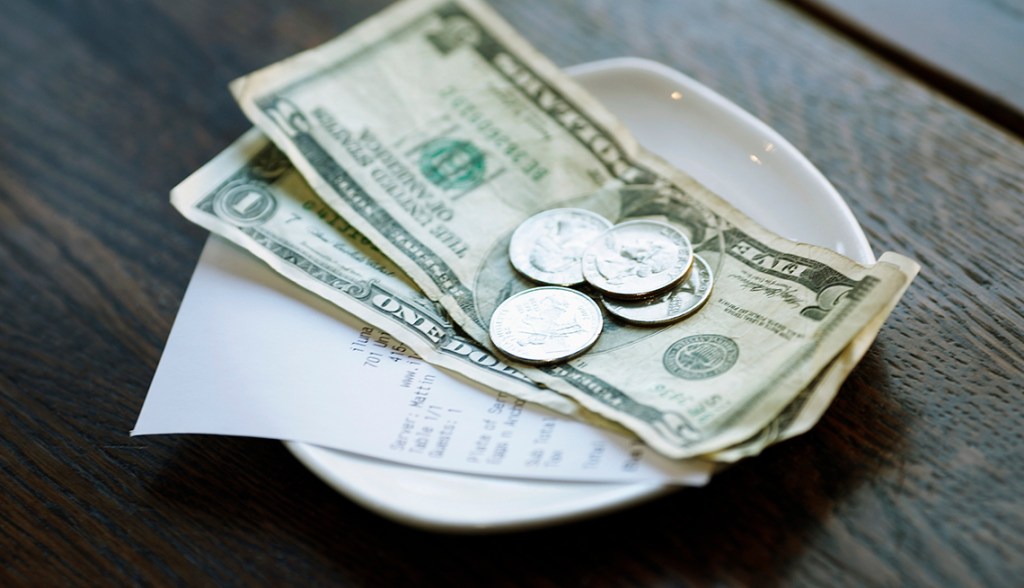
We’re at a moment of reckoning in the restaurant industry. Servers are reporting an increase in abuse from diners1 – just last month a restaurant employee was beaten unconscious by a group of unhappy customers in Memphis2, according to local reports. Restaurants are holding together their finances with duct tape and bubble gum3, adding ambiguous fees with labels ranging from “inflation” to “wellness” 4,5 to help cover rising costs. Consumers are overwhelmed and frustrated by fees, surcharges, and pop-up tip screens where none existed before.6
As The New York Times’ Food section entreated last year, the entire industry has become weighed down by one question: “To tip or not to tip?”7 Compounding the decision to leave a little extra behind once the plates are cleared is the realization that few if any customers actually know what these workers are paid in the first place. Many are unaware of the sub-minimum wage that allows a tipped employee to be paid as little as $2.13 per hour. In New York City, this figure is $10, two-thirds of the minimum wage. That’s $20,800 a year, before taxes.
What wage does your barista make? How about the cashier handing you your takeout? Is your tip a bonus on top of a fair wage — an incentive for good service — or merely a way to transfer responsibility for a fair wage to consumers? In the Fair Labor Standards Act, the U.S. government defines it as the latter, as employers are not required to pay minimum wages as long as customers make up the difference. If you know this, it colors the whole transaction in a different way.
Yet we continue to treat tipping as something extra that must be deserved.
Paying for convenience or speed is nothing new. There are fees for express lanes on busy commuter routes; for faster access to rides at amusement parks. These fees are optionally paid by a user who values the additional convenience, but are not a part of the fundamental service or product being sold. A mechanic does not expect a tip on a repair, nor does a doctor after your check-up.
Food service employs nearly 12 million people in the U.S., or 7.4 percent of the workforce. That’s more workers than are employed in the entire education system, including colleges and universities (6.2 percent), and more than all healthcare practitioners (5.8 percent).8 The striking WGA writers and SAG-AFTRA actors are just 0.001 percent of the workforce.9 Restaurant workers have an average weekly income of $458 and an average annual income of $23,815.10 More than 40 percent of restaurant workers are living with an income that’s less than double the federal poverty line, a common measure for defining low-income households, or families that cannot make ends meet.11 About two-thirds of the tipped restaurant workers in the United States are women, and these women are three times more likely than the average U.S. worker to be in poverty.12
There is no denying that raising wages will hurt businesses with already narrow profit margins. Many owners claim that they cannot operate while paying a fair wage. They’re telling the truth — pre-Civil War plantation owners had exact the same complaint about the agricultural economy they built. The solution is not to continue allowing a sub-minimum wage, but to build a business model that does not make the exploitation of employees central to its success.
Naturally, I’m not claiming that food service workers are slaves. They are being paid for their labor, just not by their employer. Restaurants offer tipped employees a venue in which to hustle for a buck, but little else. Only 14.4 percent of restaurant workers receive health insurance from their employer.13 Other benefits are even less common. The bulk of tipped employees’ earnings come directly from customers, in informal and unregulated exchanges that can be extortionate and abusive. Restaurants aren’t enslavers — they’re more like pimps.
And so it shouldn’t be surprising that tipping culture promotes sexism — along with racism and harassment. A 2008 Cornell study shows that diners allow race, gender and attractiveness to affect the amount of their tip. Worse yet, diners of all races consistently tip white servers more than Black ones.14 In a 2014 survey, 80 percent of respondents experienced sexual harassment in their restaurant workplace, and half had experienced sexual behaviors that were “scary.” Female employees receiving the $2.13 wage experienced twice the sexual harassment as women in states that paid a higher minimum wage.15 These same women were also three times more likely to have an employer suggest they objectify themselves – dressing sexier, showing more cleavage, or wearing tighter clothing – to increase income in tips.16 If you want to feel even worse about the routine degradation that women in the industry are subjected to, I recommend you search TikTok for “#pigtailtheory.”
What’s on the line isn’t just a fair wage — it’s an opportunity to provide millions of employees with a safe working environment. Harassment, abuse, and discrimination are commonplace, and will continue for as long as uninformed patrons are in control of a server’s base wage.
Danny Meyer made a valiant effort to address this problem when he announced Union Square Hospitality Group’s no-tipping policy in 2015.17 As he stated in a company newsletter: “The American system of tipping is awkward for all parties involved: restaurant patrons are expected to have the expertise to motivate and properly remunerate service professionals; servers are expected to please up to 1,000 different employers (for most of us, one boss is enough!); and restaurateurs surrender their use of compensation as an appropriate tool to reward merit and promote excellence. … Imagine, if to prompt better service from your shoe salesman, you had to tip on the cost of your shoes, factoring in your perception of his shoe knowledge and the number of trips he took to the stockroom in search of your size. As a customer, isn’t it less complicated that the service he performs is included in the price of your shoes?”18
Sadly, Meyer’s desired results did not come to fruition. Few restaurants joined the movement, and many that did later reversed their no-tipping policies. The idea was an ambitious attempt to spark wholesale change, but its ultimate weakness was the inability of consumers to shift their perspective on the perceived price of a meal at the same speed. Not enough people were immediately convinced that a $12 burger was the same as a $10 burger plus tip.
The final nail in the coffin of Meyer’s policy was the pandemic. He said of the reversal: “People did want to tip, a lot, at the beginning, when we could finally come back to eat. It was inhumane to tell our servers, ‘You may not accept that expression of gratitude.’”19
In the first two months of the pandemic, this industry lost half its jobs nationwide.20 Ninety-five percent of restaurant workers lost wages in 2020.21 One in 10 went to work with Covid symptoms because of economic pressures and inadequate paid sick leave. (Even in states mandating paid sick leave, that pay is only the hourly wage, about 25 percent of average earnings22.) Employment levels are still short of the prepandemic numbers, and the working environment is worse.23
In the post-pandemic market, workers need change like the Raise the Wage Act. If the minimum wage had kept pace with productivity over the past 50 years, it would now be $23 per hour.24 This Act would gradually raise the minimum wage to $17 an hour by 2028.25 Implementation of the Act would also gradually raise and then eliminate subminimum wages, affording workers the dignity they deserve. It would also allow a tip to truly be a tip.
Restaurant workers have heeded the familiar condescension “go get a real job.” It’s time for restaurants to follow the same advice: Build an honest business model where prosperity doesn’t rest on worker exploitation. If your numbers don’t add up, maybe it’s time for you to consider a different line of work.
Citations below comments.

Participate in the study
- “Restaurant Workers Report Abuse Both from Customers and Managers,” Nation’s Restaurant News, October 7, 2021, https://www.nrn.com/workforce/restaurant-workers-report-abuse-both-customers-and-managers.
- Myracle Evans, “Four People Arrested after Teenage Cheddar’s Host Beaten,” accessed August 13, 2023, https://www.actionnews5.com/2023/07/28/four-people-arrested-after-teenage-cheddars-host-beaten/.
- National Restaurant Association, “Restaurant Business Conditions Survey,” December 2022, https://restaurant.org/NRA/media/Downloads/PDFs/business/2023/Restaurant-Business-Conditions-Survey-Key-Findings-Dec-2022.pdf.
- J. J. McCorvey, “Restaurants Add New Fees to Your Check to Counter Inflation,” Wall Street Journal, June 2, 2022, sec. Markets, https://www.wsj.com/articles/waiter-theres-a-fee-in-my-soup-11654139870.
- Grace Dean, “Redditors in LA Are Compiling a List of Restaurants That Ask Customers to Pay Extra Fees as Diners Grow Increasingly Frustrated with Added Charges,” Business Insider, accessed August 16, 2023, https://www.businessinsider.com/los-angeles-restaurants-service-fees-tips-gratuities-charge-bill-reddit-2023-8.
- Christina Morales, “To Tip, or Not to Tip?,” The New York Times, April 19, 2022, sec. Food, https://www.nytimes.com/2022/04/19/dining/tipping-gratuity-restaurants.html.
- Morales.
- BLS, “Employment by Detailed Occupation : U.S. Bureau of Labor Statistics,” accessed February 22, 2023, https://www.bls.gov/emp/tables/emp-by-detailed-occupation.htm.
- WGA and SAG-AFTRA together represent about 176,000 union members. All other figures are courtesy of the Bureau of Labor Statistics for 2021, including total workforce, food service, education, and healthcare.
- “Private, NAICS 722 Food Services and Drinking Places, All States and U.S. 2021 Annual Averages, All Establishment Sizes Source: Quarterly Census of Employment and Wages – Bureau of Labor Statistics,” accessed August 16, 2023, https://data.bls.gov/cew/apps/table_maker/v4/table_maker.htm#type=0&year=2021&qtr=A&own=5&ind=722&supp=0.
- Resaurant Opportunities Centers United, “2020 State of the Restaurant Workers,” 2020 State of the Restaurant Workers, accessed November 26, 2022, https://rocunited.org/wp-content/uploads/sites/7/2022/06/SORW_2020.pdf.
- Sylvia A. Allegretto and David Cooper, “Twenty-Three Years and Still Waiting for Change: Why It’s Time to Give Tipped Workers the Regular Minimum Wage” (Economic Policy Institute, July 10, 2014), https://statistical-proquest-com.eu1.proxy.openathens.net/statisticalinsight/result/pqpdocumentview.pqppanelgroup_1.gispanelfour:pdfLinkUri?pdfLinkUri=%2Fftv2%2F4c4e000001fe256a.pdf&docUri=%2Fcontent%2F2014%2FR4700-50.56.xml.
- Only 14.4% of restaurant workers receive health insurance from their employer. Only 8.4% are included in a pension plan, according to Heidi Shierholz, “Low Wages and Few Benefits Mean Many Restaurant Workers Can’t Make Ends Meet,” Economic Policy Institute, accessed August 9, 2023, https://www.epi.org/publication/restaurant-workers/.
- Michael Lynn et al., “Consumer Racial Discrimination in Tipping: A Replication and Extension,” Journal of Applied Social Psychology 38, no. 4 (April 2008): 1045–60, https://doi.org/10.1111/j.1559-1816.2008.00338.x.
- “The Glass Floor: Sexual Harassment in the Restaurant Industry” (The Restaurant Opportunities Centers United, October 7, 2014), https://forwardtogether.org/tools/the-glass-floor/.
- “The Glass Floor: Sexual Harassment in the Restaurant Industry.”
- Pete Wells, “Danny Meyer Restaurants to Eliminate Tipping,” The New York Times, October 14, 2015, sec. Food, https://www.nytimes.com/2015/10/15/dining/danny-meyer-restaurants-no-tips.html.
- Ryan Sutton, “Danny Meyer Is Eliminating All Tipping at His Restaurants,” Eater NY, October 14, 2015, https://ny.eater.com/2015/10/14/9517747/danny-meyer-no-tipping-restaurants.
- “Restaurateur Danny Meyer Explains Why He Ended the No-Tipping Policy at His Restaurants,” CNBC, accessed August 16, 2023, https://www.cnbc.com/video/2023/07/06/restaurateur-danny-meyer-explains-why-he-ended-the-no-tipping-policy-at-his-restaurants.html.
- “Bureau of Labor Statistics Data,” accessed August 16, 2023, https://data.bls.gov/timeseries/CES7072200001?amp%253bdata_tool=XGtable&output_view=data&include_graphs=true.
- “ROC_COVID_Impact_2.Pdf,” accessed August 16, 2023, https://rocunited.org/wp-content/uploads/sites/7/2022/06/ROC_COVID_Impact_2.pdf.
- “NEWS: Sanders, Scott, 29 Democratic Senators, Introduce Legislation to Raise the Minimum Wage to $17 by 2028, Benefitting Nearly 28 Million Workers Across America » Senator Bernie Sanders,” accessed August 16, 2023, https://www.sanders.senate.gov/press-releases/news-sanders-scott-29-democratic-senators-introduce-legislation-to-raise-the-minimum-wage-to-17-by-2028-benefitting-nearly-28-million-workers-across-america/.
- “Avoiding, Resisting and Enduring: A New Typology of Worker Responses to Workplace Violence,” accessed August 2, 2023, https://doi.org/10.1177/09500170231159845.
- Center for Economic and Policy Research, “The $23 an Hour Minimum Wage,” August 19, 2021, https://cepr.net/the-26-an-hour-minimum-wage/.
- “The Impact of the Raise the Wage Act of 2023,” Economic Policy Institute, accessed August 17, 2023, https://www.epi.org/publication/rtwa-2023-impact-fact-sheet/.
 Elena Soderblom
Leave a comment